 Pancakeswap
 swap status, input corrections, and confirmed results
- last updated
For a wallet-submitted EVM swap, track Pancakeswap progress by matching the request to its transaction hash on the selected network. Before signing, correct the token, amount, network, recipient, and execution limits. After submission, compare the receipt and balance changes with the quote. Cross-chain, gas-free, and non-EVM routes can expose other records and completion conditions.
In short: A swap attempt reaches a final result only when the network record and resulting balances confirm what happened, not when a quote or wallet request appears.
Follow the swap from request to closure
Start by separating the proposed trade from the on-chain transaction. A displayed quote is a live estimate, while a wallet request contains the action you may sign. Check that the connected account, active network, input token contract, output token contract, amount, recipient, and execution limits still express the trade you intend. For a token chosen from a saved list, its contract address still decides which asset the transaction will move.
An ERC-20 approval may appear before the swap when the required spender lacks enough allowance to spend the input token. That approval authorizes spending; it doesn't exchange the tokens. Treat its hash and receipt separately so an approved token isn't mistaken for a completed swap. An allowance for another spender or a smaller amount won't satisfy the current request, even when the token and wallet match.
After you sign the swap, capture the resulting transaction hash. That identifier connects the wallet, the interface, and the network record. Without a hash, the request may have been rejected before broadcast, may still be waiting in the wallet, or may have encountered a submission error. Those states need different responses. Copy the hash exactly because a different character points to a different lookup.
A broadcast transaction can remain pending until the network includes or drops it. Once included, the receipt shows whether execution succeeded or reverted. A success badge in the interface is useful, but closure also requires the intended output token to reach the stated recipient and the input change to match the executed transaction. Wallets may label an included transaction confirmed before an interface has indexed the same block.
Finish by comparing three records: the quote you reviewed, the signed request, and the confirmed on-chain result. A difference isn't automatically an error because execution can vary from the quote within the accepted limit. A wrong recipient, wrong token contract, failed receipt, or output below an enforced minimum points to a different problem and shouldn't be folded into ordinary slippage. When routing splits an order, combine the delivered output rather than judging one internal transfer alone.
Status words and the evidence behind them
"Quoted" means the interface has calculated a route from available state, not that the network has reserved that price. "Awaiting signature" means the wallet still controls whether anything is submitted. "Pending" means a node knows the signed transaction, although inclusion isn't complete and another interface may not have indexed it yet.
On an EVM network, an included transaction has a receipt, while the network's finality rules and the interface's confirmation threshold determine what "confirmed" means. The receipt's execution status then separates success from a revert. "Dropped" usually means the observed node no longer carries the transaction in its pending pool, while "replaced" means another transaction from the same EVM account used the same nonce. Neither label proves a swap output; the final receipt and token movements do.
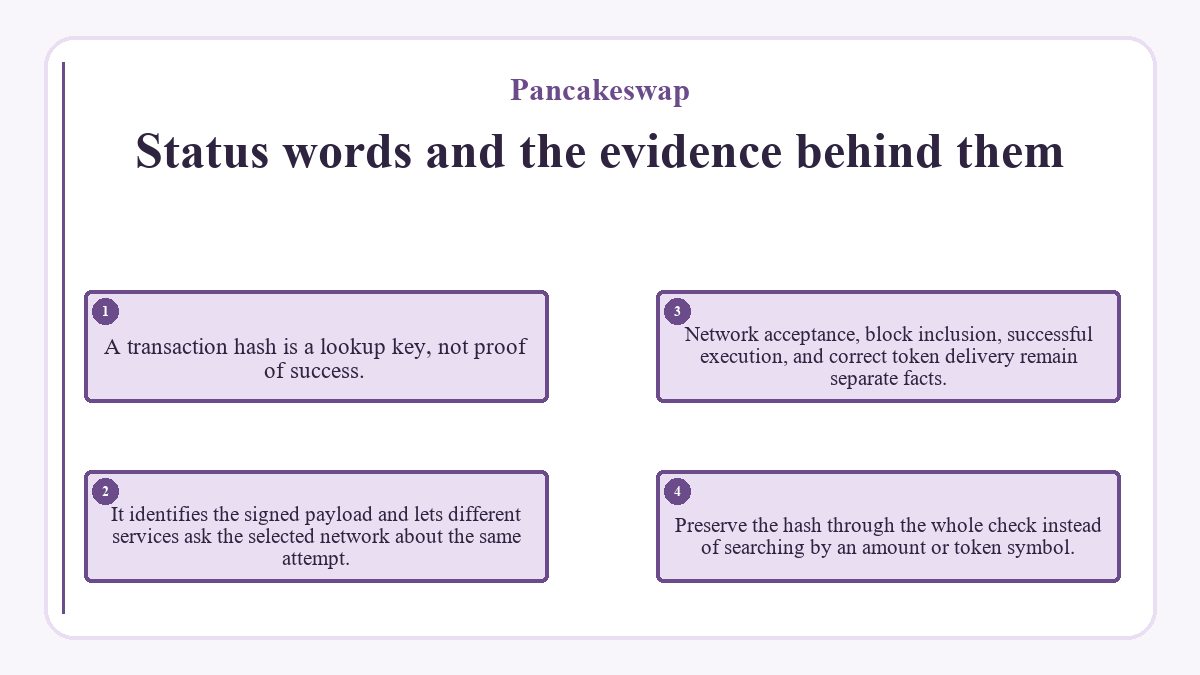
A transaction hash is a lookup key, not proof of success. It identifies the signed payload and lets different services ask the selected network about the same attempt. Network acceptance, block inclusion, successful execution, and correct token delivery remain separate facts. Preserve the hash through the whole check instead of searching by an amount or token symbol.
Has the approval finished but the swap not started?
Yes. A successful on-chain approval can finish while no swap transaction exists, because approval and execution are distinct actions. Return to the trade only after confirming the approval's spender and allowance fit the intended input. The next wallet request should have its own hash after broadcast. A signature-based permission may not create an approval transaction at all, so identify what the wallet actually requested before waiting for a second receipt.
Correct the quote before the wallet prompt
Input corrections belong before the swap signature. Correct any wrong amount, token contract, recipient, network, route preference, or execution limit where the interface allows, then obtain a fresh request. If the intended trade can't be expressed, don't sign. Editing the visible form without replacing an already opened wallet request doesn't change the data that the wallet is preparing to sign.
Read the new quote as a complete set of linked fields. The estimated output depends on the input amount, pool state, selected route, and live network conditions. Minimum received or maximum input defines the execution boundary, depending on the trade type. If any material field changes, compare the entire refreshed quote instead of carrying one acceptable number over from the previous version. A refreshed route may use different pools, so its output and fee details need a new review too.
When can changing slippage fix a failed swap?
Changing slippage helps only when the trade can execute but its actual input or output would otherwise fall outside the accepted boundary. For an exact-input swap, slippage tolerance determines the minimum acceptable output encoded for execution. Raising the tolerance widens that boundary, so it can also permit a worse fill. Lowering it narrows the allowed result and may increase the chance of a revert.
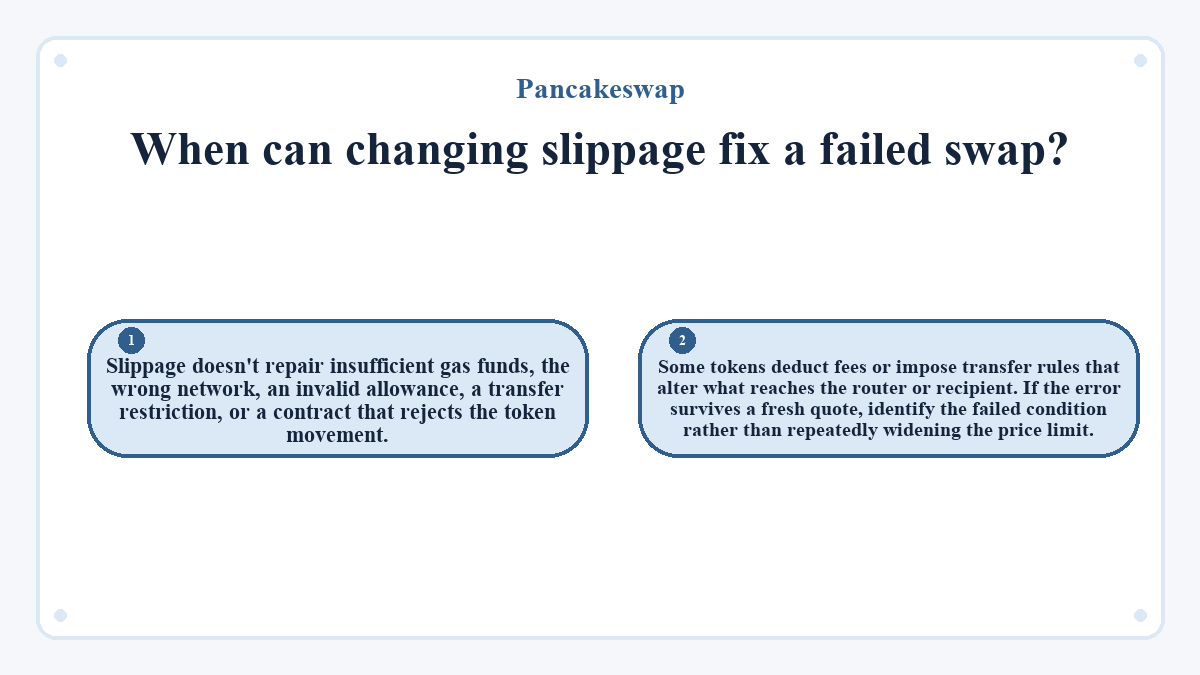
Slippage doesn't repair insufficient gas funds, the wrong network, an invalid allowance, a transfer restriction, or a contract that rejects the token movement. Some tokens deduct fees or impose transfer rules that alter what reaches the router or recipient. If the error survives a fresh quote, identify the failed condition rather than repeatedly widening the price limit.
Wait or replace a pending EVM transaction
Use this decision checklist only for an EVM transaction sent by an externally owned account that the network still reports as pending. Waiting preserves the original request. A wallet's speed-up or cancel action creates a replacement with the same account nonce, and it isn't effective until the network includes that replacement before the original.
- Confirm that the transaction hash is still pending. If a receipt already shows success or failure, replacement is no longer a valid action.
- Check the account's earlier nonces. An older pending transaction can hold later transactions in the queue even when their fees look adequate.
- Choose between waiting and replacement once. A replacement needs the same nonce and a fee that the network and wallet accept for replacement.
- Track the original and replacement hashes. The confirmed receipt identifies which signed action became part of the chain.
- Accept cancellation only after the cancel replacement confirms. A wallet button or local label alone can't prove that the original lost the race.
A pending transaction may still have competing outcomes, but an included transaction can't be edited or canceled. If the original confirms first, inspect its swap result. If the replacement confirms first, the original transaction with that sender and nonce can't later execute on that EVM chain.
Why can the interface and the network disagree?
The interface can lag because transaction history often depends on indexing, cached data, or a wallet's local queue, while the network progresses independently. Read the hash on the network selected for the swap and look for a receipt. A pending network record outweighs a stale failure banner, and a failed receipt outweighs a lingering success animation. Confirm that both views refer to the same hash before diagnosing a mismatch.
Separate the quote, minimum received, and final output
The quoted output is an estimate made before execution. The minimum received is the lower boundary for an exact-input transaction, not a prediction of the final amount. The confirmed output is the amount produced by the successful execution and transferred through the transaction. Comparing those three numbers prevents a normal in-boundary price movement from being mislabeled as a failed swap.
An EVM transaction receipt reports whether transaction execution succeeded or reverted. Use its logs and the recipient's token balance change to identify the delivered asset and raw token amount. Wallet displays may round values or omit a token that hasn't been added to the asset list. Record the network fee separately because it pays for execution and isn't another version of the quoted token output.
For a split route, several internal transfers can contribute to one delivered output. Compare the recipient's total output from that transaction with the accepted boundary, not with an intermediate pool movement. Token decimals affect display formatting, so compare the quote, limit, and delivered output in raw units for the same token contract before treating a rounded screen value as a shortfall.
Read a failed receipt without repeating the same error
A reverted EVM transaction doesn't complete the swap's state changes, although it can still consume the native gas asset. Any separate approval that confirmed earlier may remain in effect. This combination explains why the input balance can look unchanged while the gas balance falls and an allowance still exists.
First classify where the failure occurred. A rejected wallet request has no on-chain receipt. A submission problem may produce no usable hash. A reverted transaction has an included hash and failed receipt. Among these labels, only an included failed receipt proves that gas was spent on reverted execution. Before retrying, refresh the quote and correct the condition indicated by the wallet, simulation, or receipt; replaying stale inputs can reproduce the same failure.
Confirm the asset result, not just the status badge
A successful receipt is necessary, yet the asset check closes the swap. Match the receipt to the intended account and network, inspect the token contracts in the transfer records, and confirm that the output went to the expected recipient. Token symbols alone aren't enough because unrelated contracts can display the same symbol.
If the receipt succeeded but the output doesn't appear in the wallet's asset list, query the recipient's balance for the output contract on that network. A missing display entry is different from a missing transfer. If the logs show an unexpected contract or recipient, don't hide that mismatch by importing another token with a familiar name.
Close the record before attempting another swap
Keep one coherent record for the attempt: approval hash if applicable, swap hash, selected network, recipient, quoted output, execution limit, receipt status, delivered amount, and network fee. This separates a real second attempt from a delayed first one and makes duplicate signing easier to spot.
Retry only after the previous state is clear. A failed receipt calls for a fresh quote and a correction to the identified cause. A pending hash calls for waiting or a deliberate replacement on networks that support that model. A successful receipt closes the task only when the expected token reaches the recipient and its delivered amount satisfies the original acceptance boundary.
Pancakeswap - common questions
Can a failed Pancakeswap transaction still charge a network fee?
Yes. An EVM transaction that reaches a block and reverts can still consume gas because the network executed it even though the swap's state changes were rolled back. A wallet request rejected before broadcast doesn't have an on-chain receipt and doesn't consume transaction gas. Check for a hash and failed receipt before deciding which case occurred.
Why can a confirmed output token stay hidden in my wallet?
A wallet can omit a token from its visible asset list even when the recipient owns it. Match the successful receipt's transfer records to the intended output contract, network, and recipient, then read that recipient's token balance. Adding the verified contract to the wallet changes the display only; it doesn't create, move, or recover the tokens.
Does closing the browser cancel a submitted Pancakeswap swap?
No. Once a signed transaction has been broadcast, the selected network processes it independently of the browser tab. Closing or refreshing the page may remove local display context, but it doesn't revoke the signed payload. Save the transaction hash and use its network receipt to learn whether the swap remains pending, succeeds, fails, or is replaced.
Can later Pancakeswap transactions confirm before an earlier EVM nonce?
No. For conventional transactions from the same externally owned account on an EVM network, the chain enforces sequential nonces, so a later transaction can't confirm ahead of an earlier nonce. A low-fee transaction can hold later requests until it confirms or is validly replaced by another transaction using that nonce. If it is merely dropped, the nonce gap still has to be filled.