 Pancakeswap
 wallet, network, and swap limits
- last updated
Pancakeswap connects a self-custody wallet to token-swap routes, with each quote bound to a network, pool path, and execution limit. Before signing, the wallet address, active chain, input token, output contract, gas balance, and minimum received must all describe the intended trade. A quote may draw liquidity from several pool types or split an order across paths. Its displayed output can still change as pool balances and network conditions move. Review the complete quote before opening the wallet prompt: route, pool fee, price impact, slippage limit, and network fee. The final wallet prompt is where those terms become an on-chain commitment.
A usable swap starts with the correct network, enough gas, and a quote whose minimum output fits your limit.
Wallets, networks, and pools in one trade
The swap flow joins wallet ownership, chain selection, token contracts, and liquidity pools. The wallet exposes the selected address and signs transaction requests. The selected network determines which balances and contracts exist, while the router searches available liquidity for an executable path. Pancakeswap executes swaps from a connected self-custody wallet rather than placing assets in a custodial exchange balance.
Automated market maker pools use deposited reserves instead of matching each trade against a conventional order book. Their balances, pricing curves, and fee settings shape the quote. Connecting a wallet lets the interface read the selected account and request signatures; it doesn't transfer tokens. Tokens move only after the wallet authorizes a transaction, and the chosen blockchain records the confirmed result.
Why does the selected network change the trade?
Balances, token contracts, gas assets, and liquidity pools are chain-specific, so the active network changes what can be quoted and executed. A familiar ticker doesn't establish token identity by itself. The contract or mint, network, and token standard must describe the same asset that the wallet holds.
Asset identity follows the chain
Two tokens can share a symbol while using unrelated contracts, and the same project may issue or bridge representations across several networks. A wallet address can also look identical across compatible chains while holding separate balances on each one. Matching only the address or ticker can therefore produce a zero balance, an unavailable route, or the wrong token selection.
Same-chain swaps
A same-chain swap spends an input token and delivers the output on that same network. Its pools, approvals, gas payment, and confirmation all use one chain. The output won't appear on another network merely because that network uses a compatible wallet address.
Cross-chain routes
A cross-chain swap adds a transfer between source and destination networks. Availability depends on supported tokens, route liquidity, bridge capacity, and any route limits shown with the quote. Source and destination swaps may each have their own slippage condition, while bridge fees and destination delivery follow the selected cross-chain route. That path shouldn't be treated as an ordinary same-chain pool swap.
Quote fields define the swap boundary
An executable quote states both an estimate and the limits placed around it. The displayed output estimates what the route can return at that moment. Minimum received sets the lowest acceptable output after applying slippage tolerance. Price impact estimates how the order itself changes the pool price, while the network fee pays for blockchain execution.
| Quote field | Value shown | Required state before signing |
|---|---|---|
| Network fee | Estimated gas cost in the chain's native asset | Enough native gas balance on the selected network |
| Minimum received | Lowest output allowed by the active slippage tolerance | An output limit that remains acceptable for the intended swap |
| Price impact | Estimated effect of the order on the pool price | Sufficient route liquidity for the selected input size |
These fields answer different questions. Slippage tolerance limits movement between quoting and execution; it doesn't remove price impact already present in the quote. Gas also remains payable separately from the input amount. If the input is the network's native asset, spending the entire balance can leave the wallet unable to pay for execution.
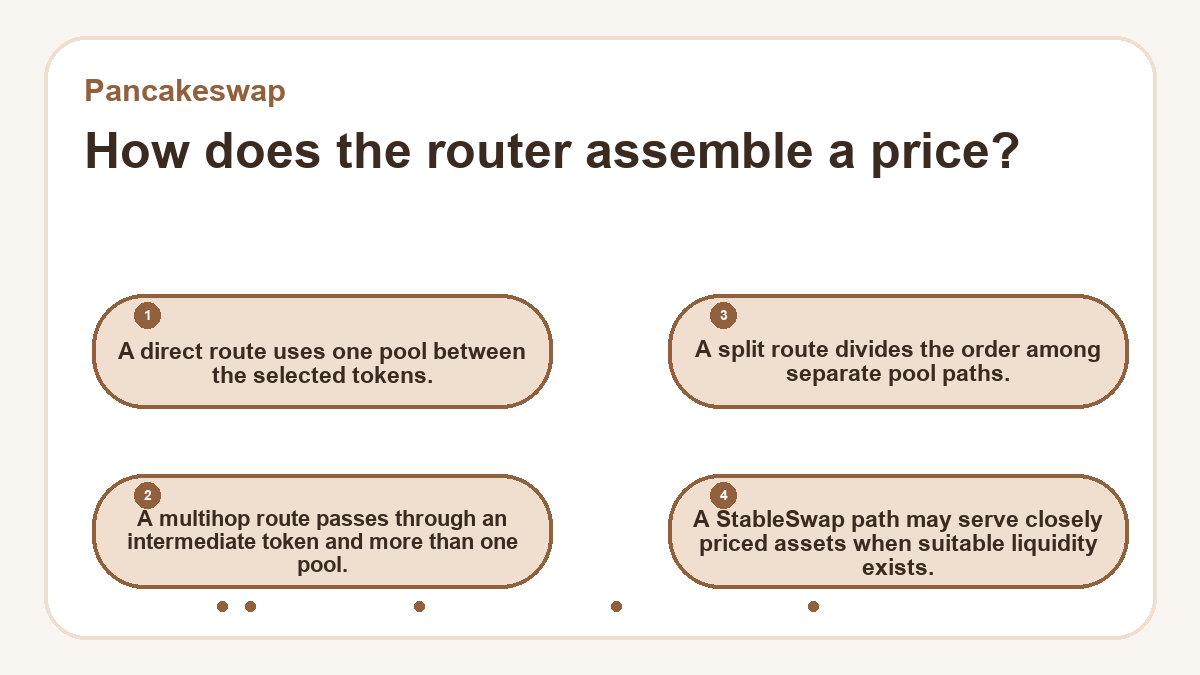
How does the router assemble a price?
The router compares available liquidity sources and constructs a path for the selected network, tokens, and amount. The smart router can combine liquidity from V3, V2, and StableSwap pools when constructing a route. The path can change when another pool or combination produces a different executable output.
- A direct route uses one pool between the selected tokens.
- A multihop route passes through an intermediate token and more than one pool.
- A split route divides the order among separate pool paths.
- A StableSwap path may serve closely priced assets when suitable liquidity exists.
Route customization changes the liquidity that the router may consider. Disabling multihop or split routing can simplify the path, yet it may also reduce available liquidity or worsen the quote. The route display matters because each hop can introduce another pool fee and another place where limited liquidity affects execution.
Approval and swap execution are separate actions
On EVM networks, a token approval grants a swap contract permission to transfer some or all of an input token. It isn't the swap itself. The wallet may present the approval and swap as separate requests, and the allowance can remain after the trade if its scope exceeds the amount spent. Native gas tokens generally don't use an ERC-20 allowance.
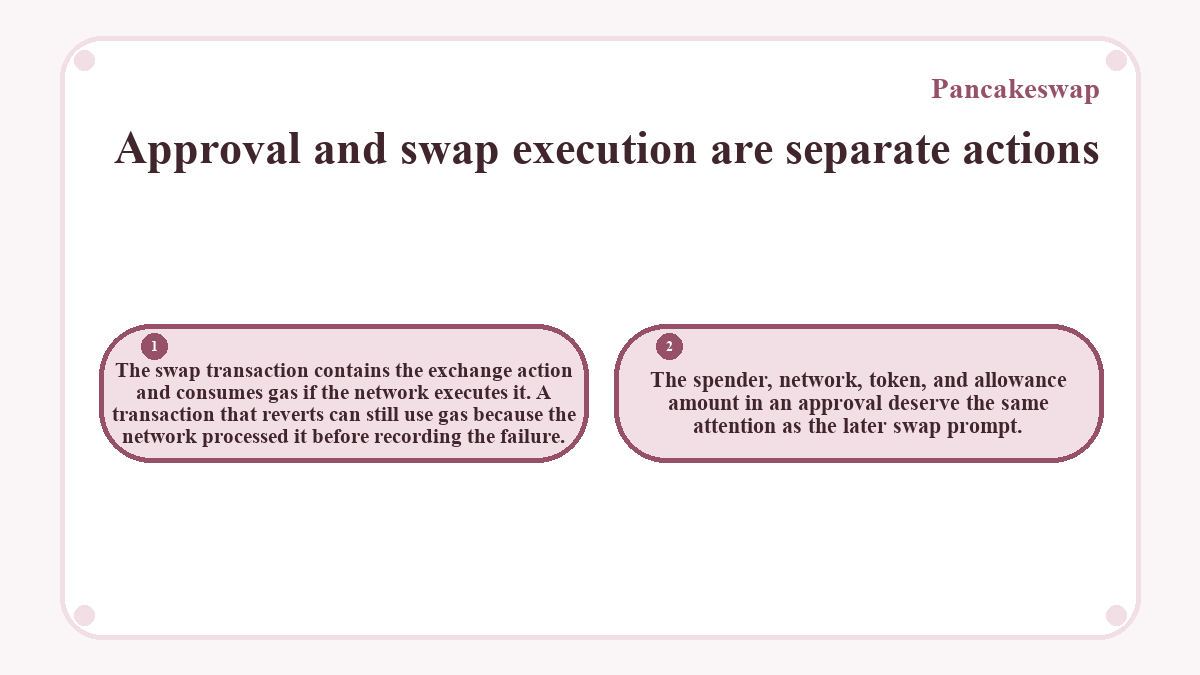
The swap transaction contains the exchange action and consumes gas if the network executes it. A transaction that reverts can still use gas because the network processed it before recording the failure. The spender, network, token, and allowance amount in an approval deserve the same attention as the later swap prompt.
Can a valid quote still fail?
Yes. A quote reflects a moment in pool and network state; it doesn't reserve that state while the wallet prompt is open. Execution can fail after the price moves beyond the permitted slippage, the transaction deadline passes, the route loses usable liquidity, the allowance is insufficient, or the wallet lacks enough gas.
Token mechanics can add another constraint. Transfer fees or restrictions may change the amount that reaches a pool, making the transaction incompatible with its encoded input or output limit. Raising slippage isn't a general repair because it widens the output range that the transaction will accept. The response should match the cause: restore the correct network or allowance, refresh a stale quote, reduce price impact with a smaller input amount, or decline a token whose transfer rules prevent ordinary execution.
Liquidity provision risks and CAKE's role
A swap trades against a pool's reserves, whereas liquidity provision deposits assets into a pool and creates a position. The position can earn a portion of swap fees, but its token composition changes as traders use the pool. Its value can also diverge from simply holding the deposited assets, a difference commonly described as impermanent loss.
Pool design affects how that position behaves. Concentrated-liquidity positions assign capital to a chosen price range and stop earning swap fees while the market sits outside that range. Other pool types keep liquidity across a broader curve or use different accounting. Fee tier, current range, token behavior, and withdrawal conditions belong to the position decision rather than the ordinary swap quote.
CAKE appears in the wider ecosystem, including pools and incentive mechanisms, but it isn't required as one side of every swap. It also isn't the gas asset across every supported network. A trader needs the selected input token and the native asset required by that chain.
The signature is the final decision point
A swap is ready to sign only when the wallet prompt agrees with the quote on the network, contract action, and spend amount. Contract identity matters because a ticker, logo, or imported token name can be copied. The wallet should also show the expected account, since changing accounts can silently change balances, approvals, and the source of gas.
After confirmation, the transaction record provides the durable evidence: status, tokens transferred, amounts, fees, and the receiving address. A pending label isn't completion, and an interface message doesn't override a reverted receipt. Pool fees also vary with the pool selected by the route rather than following one universal rate. V3 pools on EVM networks document fee tiers of 0.01%, 0.05%, 0.25%, and 1%.
Pancakeswap: quick answers
Is an account required for a Pancakeswap swap?
No. A standard on-chain swap uses a connected wallet instead of a custodial trading account. The wallet address identifies balances and signs permissions on the selected network. Connecting alone doesn't transfer a token; an approval or swap request must still be signed.
How long does a swap quote stay usable?
There is no single fixed lifetime for every quote. Pool balances, market activity, gas estimates, and available routes can change between viewing and signing. The transaction's slippage and deadline conditions determine whether execution may proceed, but they don't freeze the displayed rate. Refreshing the quote before signing shows whether the route, minimum received, or network fee has changed.
Does Pancakeswap decide the blockchain gas fee?
No. Network demand, transaction complexity, and the chain's fee mechanism determine the gas requirement, while the wallet estimates what to submit. Pancakeswap pool fees are separate and belong to the chosen route. A failed on-chain attempt may still consume gas because the network processed the transaction even though the swap didn't satisfy its execution conditions.
Why can a visible token lack a usable quote?
A visible token can lack a quote when it is on the wrong network, has no supported pool path, or has too little usable liquidity for the requested amount. A copied ticker may also point to a different contract than the intended asset. Matching the network and token contract separates an identity problem from a route or liquidity problem.
After a swap confirms, can it be reversed?
A confirmed on-chain swap generally cannot be reversed. Before confirmation, some wallets and networks may support replacing or canceling a pending transaction, but success depends on its status and transaction rules. Once included and finalized, the transfer follows the executed contract call. The transaction receipt shows whether the swap succeeded, reverted, or remains pending.